Tampilkan postingan dengan label Asteroids. Tampilkan semua postingan

Minggu, 03 November 2013

A Comet Masquerading as an Asteroid

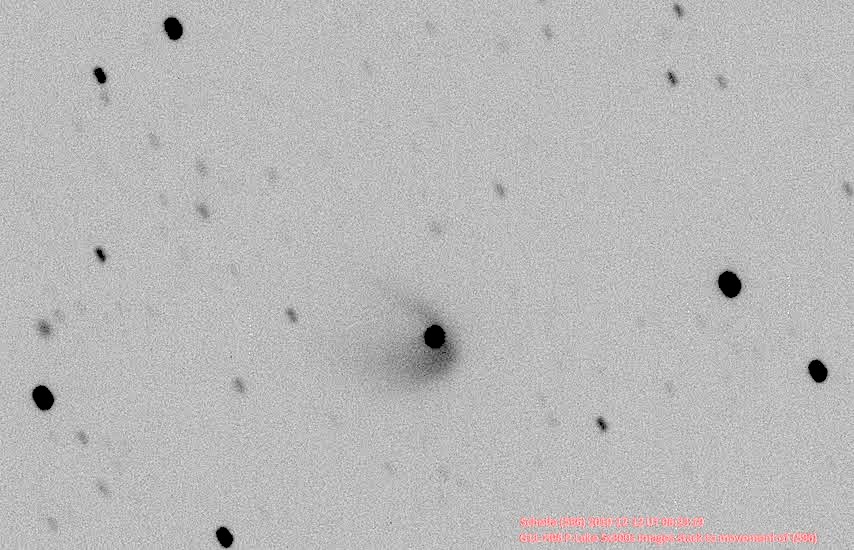
596 Scheila, the asteroid with a tail. Image credit: Peter Lake


When is an asteroid not an asteroid? When it turns out to be a comet, of course. Has this ever happened before? Why, yes it has. In fact it was just announced December 12, 2010 that the asteroid (596) Scheila has sprouted a tail and coma!

Steve Larson of the Lunar and Planetary Laboratory (LPL), University of Arizona first reported that images of the minor planet (596) Scheila taken on December 11th showed the object to be in outburst, with a comet-like appearance and an increase in brightness from magnitude 14.5 to 13.4. The cometary appearance of the object was confirmed be several other observers within hours.

A quick check of archived Catalina images of Scheila from October 18, November 2 and November 11 showed Sheila to look star-like, which is what asteroids look like from Earth. They just happen to be moving across the field of view in contrast to the fixed background stars. The image taken by Catalina on December 3rd shows some slight diffuseness and an increase in overall brightness. So, it appears this event began on or around December 3rd.

Upon hearing the news, there was some speculation that this might be evidence of an impact event. Had something crashed into asteroid Scheila? It seems unlikely, and this is a story we have heard before.

The asteroid discovered in 1979 and named 1979 OW7 was lost to astronomers for years and then recovered in 1996. It was subsequently renamed 1996 N2. That same year it was discovered to have a comet-like appearance, and many believed this was the signature of an impact between two asteroids. After years of inactivity 1996 N2 sprouted a tail again in 2002. One collision between two asteroids was unlikely enough. The odds of it happening again to the same object were essentially zero. What we had was a comet masquerading as an asteroid. This object is now known by its cometary name 133P/Elst-Pizarro, named after the two astronomers who discovered its initial cometary outburst.

The 2002 outburst and the discovery of more active asteroids showing mass-loss led to a paper (Hsieh and Jewitt 2006, Science, 312, 561-563) introducing an entirely new class of solar system objects, Main Belt Comets (MBC). MBCs look like comets because they show comae and have tails but they have orbits inside Jupiter's orbit like main belt asteroids.

The most likely cause of the mass loss activity in MBCs is sublimation of water ice as the surface of the MBC is heated by the Sun. This is suggested most strongly by the behavior of the best-studied example, namely 133P/Elst-Pizarro. Its activity is recurrent, and it is strongest near and after perihelion, the point in its orbit nearest the Sun, like other comets.

MBCs are interesting to astronomers because they appear to be a third reservoir of comets in our solar system, distinct from the Oort cloud and Kuiper belt. Since we know of no way for theses other reservoirs to have deposited comets in the inner solar system, the ice in MBCs probably has a different history than the ice in the outer comets. This allows researchers to study the differences in the Sun�s proto-planetary disk at three separate locations. This might lead to information on the Earth�s oceans, one of the continuing lines of investigation by solar system scientists.

Now it seems we have another MBC to add to the sample. And Scheila will probably be getting a new name soon. Asteroid (596) Scheila was discovered Feb. 21, 1906, by A. Kopff at Heidelberg. The 113Km in diameter �asteroid� was named after an acquaintance, an English student at Heidelberg. In the future it will be called XXXP/Lawson or something similar, and Kopff�s Sheila will become just another footnote in the history of astronomical nomenclature.

Venus Has a Moon?

Venusian quasi-satellite 2002 VE68
Illustration: NASA/JPL/Caltech
Astronomers have been busy trying to determine the spin period and composition of Venus' moon. December 8, 2010, results were announced by JPL/Caltech scientists, led by Michael Hicks.

"Wait a minute; back up", I hear you ask. "Venus has a Moon?"
Of course it does. Well, kind of...
Let me explain.

It has the rather unfortunate name of 2002 VE68. That is because it was discovered on November 11, 2002 by LONEOS, the Lowell Observatory Near Earth Object Search. 2002 VE68 is an earth orbit -crossing asteroid that has been designated a Potential Hazardous Asteroid by the Minor Planet Center. For obvious reasons, this makes it a very interesting subject of study for JPL scientists.

2002 VE68 used to be a run of the mill, potential impact threat, Near Earth Object. But approximately 7000 years ago it had a close encounter with Earth that kicked it into a new orbit. It now occupies a place in orbit around the Sun where at its closest it wanders inside the orbit of Mercury and at its furthest it reaches just outside the orbit of the Earth. It is now in a 1:1 orbital resonance with Venus.

An orbital resonance is when two orbiting bodies exert a regular, periodic gravitational influence on each other due to their orbital periods being related by a ratio of two small numbers. For example, Pluto and Neptune are in an orbital resonance of 2:3, which simply means for every two times Pluto goes around the Sun, Neptune makes three trips around.

In the case of Venus and 2002 VE68, they both take the same time to orbit the Sun once. They are in a 1:1 orbital resonance. So by definition, 2002 VE68 is considered a quasi-satellite of Venus. If you watch the Orbital Viewer applet at the JPL small body page you can watch this celestial dance as the two bodies orbit the Sun and each other as 2002 VE68 dodges Earth and Mercury in the process.

Often these resonances result in an unstable interaction, in which the bodies exchange momentum and shift orbits until the resonance no longer exists. In this case, scientists believe 2002 VE68 will only remain a Venusian quasi-satellite for another 500 years or so.

So getting back to the story, Hicks and his team used the recent close apparition of 2002 VE68 to do photometric measurements over the course of three nights in November using the JPL Table Mountain 0.6m telescope near Wrightwood, California. From the color data they obtained they determined that 2002 VE68 is an X type asteroid. This is a group of asteroids with very similar spectra that could potentially have a variety of compositions. They are further broken down into Tholen classification types as either E, M or P types. Unfortunately Hicks' team was not able to resolve the sub-classification with their equipment.

They were able to determine the approximate size of the asteroid to be 200 meters in diameter, based on its absolute magnitude, and they determined a spin rate of 13.5 hours. The amplitude of the fluctuation on the light curve of 2002 VE68 could imply hat it is actually a contact binary, two clumps of asteroidal material orbiting a center of mass in contact with each other.

For more information on some of the strange and curious beasts in the asteroidal zoo, visit the NASA Near Earth Object Program website.

(93) Minerva is a Triple Asteroid

It doesn't happen often, sometimes with variable stars or new novae, but today I get to scoop the IAU before it puts out a circular.

The headline reads: (93) Minerva is a Triple Asteroid

Minerva was discovered on August 24, 1867 and named after Minerva, the Roman goddess of wisdom. It is a large main belt, C Type asteroid (carbonaceous asteroids). This type of asteroid has very similar spectra to carbonaceous chondrite meteorites. This chemical composition is approximately the same as the Sun and the primitive solar nebula, except that they do not contain hydrogen, helium and other volatiles. C-type asteroids have extremely dark albedos, so even the largest ones require a telescope to view them.

The story of the discovery of Minerva's two companions was actually a matter of some luck. The astronomers (F. Marchis, B. Macomber, J. Berthier, F. Vachier, J.P. Emery) using the Keck Adaptive Optics system found they had extra time in their observing program because the slewing and imaging of the telescope was more efficient than they had anticipated. Even though their observing program was to look for binary S-type asteroids (which have brighter albedos) they decided to look at a few large C-type asteroids, not previously observed with adaptive optics, to fill in their observing run.

The high resolution images provided by the Keck AO system revealed that asteroid 93 Minerva has 2 tiny km-sized moons in orbit around the large 140-km primary. The two moons are 4 and 3 km in size and orbit the primary some 630 km and 380 km away respectively.

There are not many known triple asteroids. We know that (87) Sylvia (45) Eugenia and (216) Kleopatra each possess two moonlets. These were all discovered by the same team that discovered (93) Minerva's satellites. There are two triple asteroids in the Near-Earth Asteroids and 2 more (including Pluto) in the TransNeptunian Object population. And that is where the count stands as of today.

So why do we care about binary or triple asteroids? Astronomers anticipate finding clues to their formation and evolution, as well as conditions in the early solar system. For example, an article published in Nature (Aug 2005), claims the 87 Sylvia triple system was most probably formed through the disruptive collision of a parent asteroid. The new primary formed from accretion of fragments, while the moonlets formed from the debris. These asteroids can teach us about the violent collisions and processes that made our solar system what it is today.